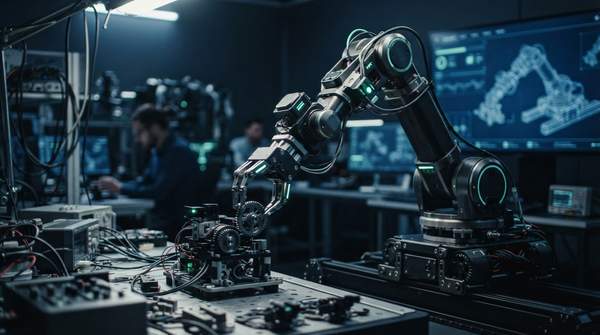
Physical AI is the emerging field in which artificial intelligence models are combined with sensors and actuators so that machines can sense their surroundings, make autonomous decisions, and act in the physical world—learning from data rather than following fixed, pre-programmed instructions. The definition matters because it distinguishes this new paradigm from two familiar neighbors: the deterministic industrial robot on a factory line and the chatbot that analyzes data but never touches anything. As Akkodis, a digital engineering firm, describes it, physical AI systems combine sensors, AI models, and actuators to make autonomous decisions in real time.
What is Physical AI?
At its core, physical AI closes the loop between perception and action. A physical AI system does not merely interpret a stream of data; it uses that interpretation to move through and manipulate an environment. Akkodis cites industrial robots, autonomous vehicles, and smart factory systems as concrete examples—all machines that must act on what they sense, under conditions that can change without warning.
What separates this from older automation is how behavior is produced. In a traditional robotic setup, engineers anticipate the task's conditions and encode them: positions, sequences, tolerances. The Association for Advancing Automation, a robotics industry trade group, notes that AI has been applied for several years to analyzing large datasets quickly, accelerating research by identifying and cataloguing information. That kind of intelligence lived on servers. Physical AI brings it into the world of moving parts.
The decisive shift is that behavior is learned rather than written. The industry guide published on Acrosser, an industrial computing company's site, explains that physical AI robots leverage learning techniques such as deep learning and reinforcement learning to improve performance—and can refine behaviors with data, for example improving a grasp after failed attempts, rather than requiring a human to rewrite code. That single sentence captures the field's promise: a machine that gets better at its job through experience.
Comparing Physical AI, Traditional Robotics, and Data-Centric AI
The clearest way to understand physical AI is to place it beside its two closest relatives. Traditional robotics and conventional data-centric AI each hold one half of the picture—precise physical action in the first case, intelligent analysis in the second. Physical AI fuses the two halves. The table below juxtaposes the three approaches across four dimensions drawn from industry descriptions of the field.
| Dimension | Physical AI | Traditional Robotics | Traditional (Data-Centric) AI |
|---|---|---|---|
| Core function | Combines sensors, AI models, and actuators to make autonomous decisions and act in real time | Performs precise, repetitive tasks governed by pre-programmed rules | Analyzes big datasets to make predictions, generate content, or identify patterns in digital environments |
| Adaptability / learning | Learns from data—deep learning and reinforcement learning—to improve behavior, such as refining a grasp after failed attempts | Limited adaptability; follows pre-programmed rules and fails when conditions change | Improves on analytical tasks, but has no physical mechanism to adapt |
| Decision-making basis | Learned, data-driven decisions made autonomously in real time | Deterministic algorithms or simple feedback loops, without learning | Statistical patterns extracted from data, with no physical consequence |
| Environment interaction | Senses and acts in dynamic physical environments; handles unfamiliar objects and recovers from errors without reprogramming | Operates in fixed conditions; unexpected changes can break the task | Operates in digital settings, such as chat interfaces and browser-based agents |
The comparison reveals why physical AI is a synthesis rather than a rebrand. Traditional robots excel at repetition but brittlely: as Akkodis puts it, they follow pre-programmed rules and fail when conditions change. Data-centric AI is flexible in its reasoning but disembodied. Physical AI inherits the robot's capacity for physical action and the model's capacity to learn, producing machines that, in Akkodis's words, can handle unfamiliar objects, recover from errors, and navigate new environments without reprogramming.
Primary Applications of Physical AI
Where is this paradigm actually being deployed? Akkodis reports that physical AI is already reshaping manufacturing, logistics, automotive, healthcare, construction, and urban infrastructure—a breadth that reflects how general the underlying capability is. Any environment where a machine must perceive variable conditions and act on them is a candidate.
In manufacturing and logistics, the value proposition is straightforward. Classical automation requires that every object arrive where the robot expects it to be; learning-based systems can tolerate disorder on the line or in the warehouse. In automotive, autonomous vehicles are the flagship case: a system that must sense, decide, and act continuously in an open, unpredictable world. Healthcare, construction, and urban infrastructure extend the same pattern to settings where no two situations are identical.
Two caveats keep this picture honest. First, physical AI's advantage over traditional robots is conditional, not absolute—it performs better precisely in the situations where pre-programming breaks down, namely unfamiliar objects, errors, and new environments. Second, the application areas above are illustrative of a field still emerging, not a census of deployments; the sources cited are industry actors with a stake in the technology's adoption, and their claims about impact should be read in that light.
The Future of Physical AI: An Observable Shift
The practical takeaway for any reader trying to place this field: recognize physical AI as a transformative paradigm enabling machines to autonomously sense, reason, and act in dynamic physical environments—not as a marketing term for better robots. The distinction is real and testable. If you want to judge whether the field is delivering, the indicator to watch is the increasing deployment of autonomous robots and systems capable of learning and adapting in dynamic physical environments across industries, driven by advances in AI, robotics, sensors, and simulation. Where a machine improves its own grasp after failed attempts, or recovers from an error without a human rewriting code, that is physical AI operating as described—no buzzword required.