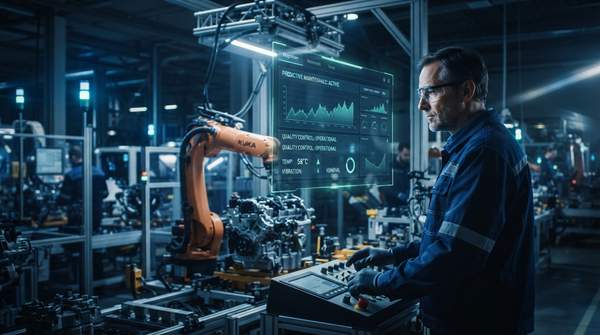
For most manufacturers, industrial AI earns its keep in two places: predicting equipment failures before they happen, and catching product defects faster and more consistently than human inspectors can. Everything else—supply chain optimization, autonomous process adjustment—is real but secondary. The harder question is not whether AI works, but whether your operation is ready for it. This guide explains the two highest-impact applications, the benefits and obstacles reported by companies that have deployed them, and a three-phase framework for deciding which, if any, AI investment fits your plant.
Introduction to Industrial AI in Manufacturing
Industrial AI is not a single product but a set of machine learning and deep learning techniques applied to the torrents of data that modern factories already generate. As Arm's technical glossary defines it, AI in manufacturing is the use of machine learning solutions and deep learning neural networks to optimize manufacturing processes through improved data analysis and decision-making. The raw material is abundant: industrial IoT sensors and smart factory equipment produce large volumes of data daily, much of which historically went unused.
What makes AI different from conventional automation is pattern recognition at scale. IBM's overview of AI in manufacturing describes systems that analyze data from sensors, equipment, and production lines to anticipate potential issues, suggest improvements, and even autonomously adapt processes in real time. Coursera's applications review groups the main uses into three families: predictive maintenance, quality control, and supply chain management. The first two dominate in practice because they attack the two largest recurring costs in any plant—unplanned downtime and defective output.