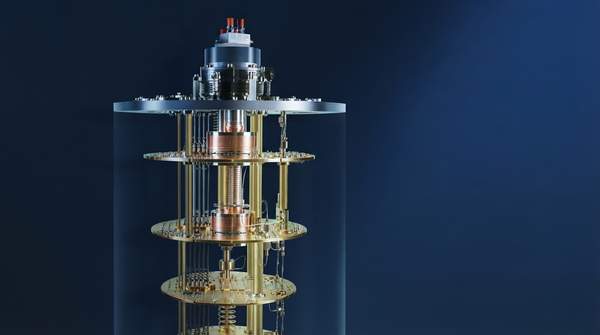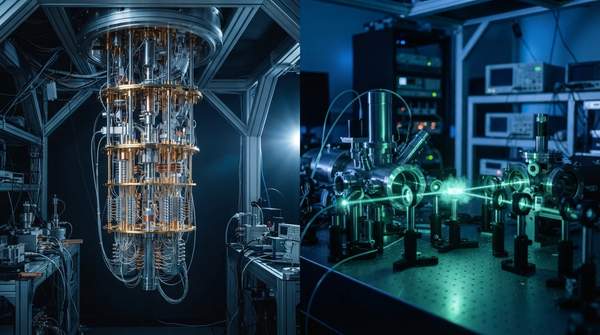
Quantum computers are cooled in two fundamentally different ways, depending on the qubit technology at their core. Superconducting machines chill their entire processor to around 10–20 millikelvin — a fraction of a degree above absolute zero and colder than deep space — using large dilution refrigerators that mix helium isotopes. Neutral-atom machines instead keep the hardware at room temperature and use lasers to slow individual atoms to microkelvin temperatures inside a small vacuum cell. The choice between these two paradigms is not aesthetic: it dictates a system's power draw, physical footprint, and whether it can be installed in an ordinary data center.
Why Extreme Cold Is Necessary at All
The physics problem is decoherence. A qubit's usefulness rests on maintaining delicate quantum states, and thermal energy — the ambient vibration of atoms — disrupts those states and introduces errors into calculations. Cooling suppresses that vibration, which is why cryogenic operation allows, in the words of one vendor's technical glossary, "longer coherence times, higher fidelity quantum operations, and improved overall performance of quantum computers."
Not every quantum computer faces the same thermal burden. Superconducting qubits are electrical circuits that only exhibit quantum behavior when cooled to around 10–20 millikelvin, according to neutral-atom developer QuEra's technical materials. Photonic approaches typically need cryogenically cooled single-photon detectors rather than a fully refrigerated processor. Neutral-atom systems take a different path entirely, one that relocates the cooling problem from the whole apparatus to the atoms themselves.