The advanced robots now moving through warehouses, factory floors, and shared human workspaces do something traditional industrial arms cannot: they perceive. Two technologies make this possible. Sensor fusion merges data from cameras, LiDAR, radar, and other sensors into a single coherent model of the environment, and AI algorithms interpret that model to recognize objects, plan paths, and adapt in real time. We see this pairing identified again and again, from academic reviews of mobile robotics to vendor documentation for autonomous mobile robots, as the engine driving industrial robots beyond simple repetitive tasks into complex, adaptive operations in dynamic environments.
From Sensing to Action: The Robotic Intelligence Pipeline
The abstract phrase "AI-powered robotics" becomes concrete when you break it into four sequential stages. In the first, sensing, the robot gathers raw measurements from multiple, physically different sensors. In the second, fusion, those measurements are combined into one unified environmental model. In the third, AI analysis, algorithms interpret that model — recognizing objects, predicting motion, planning routes. In the fourth, action, the robot executes a physical task such as navigating around a worker or picking up a part. Each stage depends on the one before it, and the distinct roles of sensing, fusion, and AI only become clear when you trace the flow from raw data to intelligent movement.
The sensing layer starts with complementary sensor types, each contributing data the others cannot. The table below maps sensors to their data contributions and what fusion makes of them.
| Sensor | Data contribution | Role in the fused model |
|---|---|---|
| LiDAR | Precise distance measurements and detailed 3D mapping of the environment | Accurate localization and mapping for mobile robots |
| Cameras (including stereo and thermal) | Visual data on color, texture, and detailed object features | Object recognition and detailed environmental understanding |
| Radar | Range and velocity data, robust in dust, glare, and low light | Cross-modal consistency check; detects moving obstacles cameras and LiDAR can miss |
| Other modalities (IR, ultrasonic, tactile) | Non-visual proximity and contact signals | Navigation where visual cues are limited or absent, such as mines, tunnels, and underwater |
Why combine them at all? Because individual sensors fail in different ways. A review of sensors and sensor fusion in mobile robots by K. S. Nagla and Sanjay Yadav notes that navigation sensors are often affected by errors and uncertainties, and that fusion emerged specifically to overcome those limitations and improve perception, navigation accuracy, and decision-making. Texas Instruments' robotics sensing documentation makes the point from the engineering side: radar provides the velocity and range dimension that cameras lack, and combining it with RGB or thermal imaging through an AI fusion pipeline closes the modality gap in environments where any single sensor is insufficient. Fusion, in short, is not redundancy — it is compensation.
The AI stage is where fused perception becomes behavior. Embedded vision specialist TechNexion describes two key functions: AI models learn complex patterns in sensor data, such as recognizing objects or predicting robot behavior in dynamic environments, and machine learning enables real-time adaptation to environmental changes, improving decision-making even under noisy, uncertain conditions. In practice, KUKA's autonomous mobile robots illustrate the full pipeline in one system: LiDAR, laser scanners, cameras, and onboard navigation systems are fused in real time using SLAM (Simultaneous Localization and Mapping) to determine position, build digital maps, detect obstacles, and optimize routes.
Key Capabilities Unlocked by AI and Sensor Fusion
Three capabilities follow directly from this pipeline, and they explain most of what is new in industrial robotics.
- Adaptive navigation and obstacle avoidance. Mobile robots using fused LiDAR and camera data with SLAM can localize, map, and re-route in dynamic spaces. TI's radar systems add velocity-annotated point clouds that detect moving obstacles — including distinguishing human workers from robots and static infrastructure in dense factories, which demands high angular resolution and per-point Doppler velocity fed into an AI inference pipeline.
- Complex object recognition and manipulation. Vision systems supply color, texture, and 3D shape; AI interprets them. Yet a review of AI in industrial robotics cautions that many automation cases remain limited by AI issues in object recognition, position recognition, and decision generation for grabbing and manipulating — a reminder that this capability, while transformative, is not solved everywhere.
- Human-robot collaboration. Sensor and imaging advances are opening new applications in shared workspaces, where monitoring interactions and adapting to human presence are prerequisites rather than extras.
The same review of AI-empowered industrial robotics draws the honest boundary: most remaining limitations — recognition accuracy, varying environmental conditions, the sheer number of possible situations — relate to perception and control software, not the robots' mechanical systems. That is precisely why computer vision, sensor fusion, and machine learning are described there as the major engines driving industrial robots' wider application.
Industrial Applications: Robotics in Action
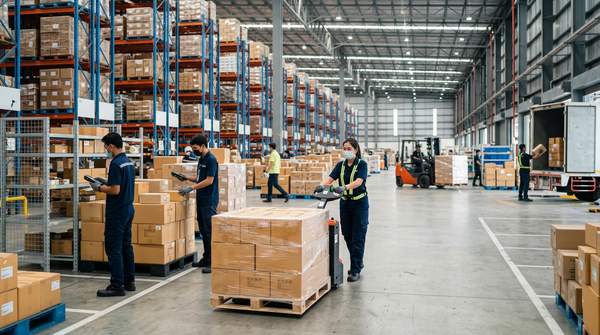
In logistics, autonomous mobile robots already run this pipeline end to end: KUKA reports AMRs operating across production and warehouse environments with real-time fleet monitoring and integration into ERP, WMS, and MES systems, serving e-commerce and electronics manufacturing where speed and flexibility dominate. Non-vision sensing suites matter in harder spaces, too — a sensor-fusion navigation review notes that IR, tactile, ultrasonic, LiDAR, and radar inputs let robots navigate warehouses, mines, and tunnels where visual cues are limited or nonexistent.
In manufacturing, reviews of industrial robotics observe that machines are expanding beyond traditional assembly into logistics, healthcare, and agriculture through AI, machine learning, and advanced sensors. A survey of AI in industrial robotics adds concrete research anchors: systematic reviews of mobile robot obstacle avoidance and path planning spanning graph search through deep reinforcement learning, sensor fusion strategies for local perception and localization in complex environments, and AI improving the precision of intelligent welding execution. Labor shortages are a stated driver — many machine vision and sensor-fusion solutions (camera–LiDAR, camera–distance sensor pairings) have been implemented spontaneously in industrial enterprises precisely because skilled labor is absent. These are illustrative applications, not an exhaustive survey, and they are enabling technologies rather than a market ranking of specific vendors.
Empowering Future Industrial Automation
Businesses considering advanced robotics should prioritize systems that effectively integrate multi-modal sensor fusion with AI for robust perception and adaptive decision-making, especially in dynamic or challenging environments. The pipeline logic makes the evaluation concrete: check which sensing modalities a system actually fuses, how it handles degraded conditions where any single sensor fails, and whether its AI adapts in real time rather than replaying fixed routines. The measurable indicator to watch is improved operational efficiency, reduced errors in complex tasks, and enhanced safety in human-robot collaborative workspaces — the outcomes this technology stack exists to deliver.
Sources
- Sensors and Sensor Fusion in Mobile Robots: Emerging Technologies and Approaches — SpringerLink
- MDPI: AI algorithms interpret that model
- Autonomous mobile robotics (AMR) in logistics and production — KUKA Global
- TI
- Multi-Sensor Fusion Techniques for Improved Perception in Robotics — TechNexion - Embedded Vision | MIPI CSI-2 | USB | GMSL2 | GigE Vision | Edge AI Vision
- AI-empowered intelligence in industrial robotics: technologies, challenges, and emerging trends — Oaepublish
- MDPI: sensor-fusion navigation review
- Advanced robotics technology for Industry 4.0 — imec