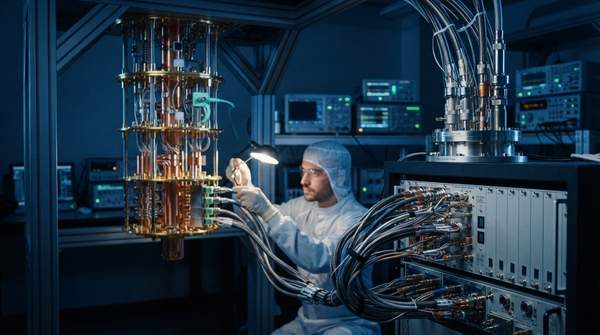
Every superconducting quantum computer is, in a very literal sense, two machines bolted together across a 300-degree temperature gap. At the bottom of a dilution refrigerator, qubits sit near a hundredth of a degree above absolute zero; at the top, racks of ordinary classical electronics generate the microwave pulses that make those qubits do anything at all. The bridge between the two is the radio-frequency (RF) control layer—a signal chain of waveform generators, IQ mixers, specialized cryogenic wiring, and cryogenic amplifiers that determines whether a quantum processor can be controlled at all, let alone scaled to millions of qubits.
The chain works in a cycle. A control computer sends microwave pulses down into the refrigerator to set qubit states; readout pulses reflect back out through amplifiers and isolators, are digitized, and are classified as a 0 or a 1, as Berkeley Nucleonics' technical reference on quantum hardware layers describes. This article traces that signal path stage by stage and then examines why the RF layer is where many of quantum computing's hardest scaling problems live.
The Quantum RF Control Layer: An Overview
Architecturally, a quantum computer is usually drawn in layers precisely so that no single discipline has to comprehend the whole machine at once. The quantum data plane holds the qubits; everything else exists to initialize, control, couple, and read them out. The RF layer is the classical half of that bargain. It is not an accessory: as one Berkeley Nucleonics hardware overview puts it, "the signal source is on the critical path"—a quantum computer can never run faster than the time needed to create its precise control signals, even though today's electronics are fast enough that gate speed is generally limited by the quantum data plane rather than the control hardware.
The scale of the engineering problem is what makes this layer interesting. NIST frames its multi-laboratory RF calibration effort around getting "from qubit to mega-qubit" machines, describing ultrasensitive calibrated cryogenic on-chip microwave measurements as essential for understanding, designing, testing, and scaling the microwave circuits that surround, initialize, control, couple, and read out qubits. In other words, the path to a million-qubit machine runs substantially through RF measurement and calibration—classical microwave engineering performed at temperatures where almost nothing behaves conventionally.
What follows is the control-and-readout cycle for superconducting qubits specifically. Other qubit modalities, such as trapped ions or photonic systems, use entirely different control technologies, most often lasers, and are outside this model.