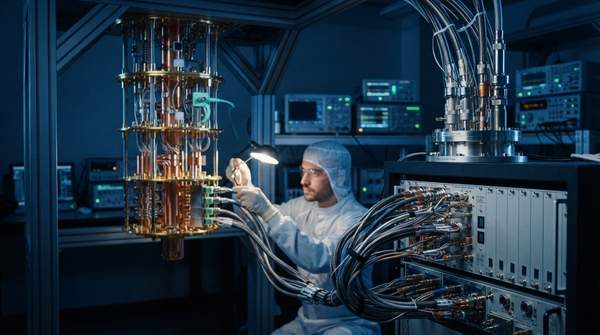
Quantum Key Distribution promises encryption keys whose security rests on physics rather than computational hardness—but the National Security Agency does not currently recommend it for National Security Systems, and the reasons are practical, not theoretical. The protocols differ meaningfully in how they encode information, how far they can reach, and how fragile their security is in real hardware. Here we break down the main QKD approaches, the NSA's specific objections, and the technologies—quantum repeaters and Twin-Field QKD—being built to close the distance gap.
Understanding Quantum Key Distribution (QKD) for Enterprise Security
QKD is one of the most mature applications of quantum communication, according to a NASA primer on the field. It lets two parties—conventionally called Alice and Bob—generate shared encryption keys using single photons, with proof-of-concept demonstrations in many countries and commercial systems already offered by a few providers. The appeal for enterprises is straightforward: any eavesdropper who intercepts the quantum states disturbs them in a detectable way, so Alice and Bob can compare a subset of their measurements, spot the intrusion, and discard compromised key material.
That detection property comes from quantum mechanics itself. As NASA's primer explains, measuring a quantum state erases the information it carried—once you measure a photon's polarization and obtain an outcome, the original encoded amplitudes are gone. This invasive role of measurement has been leveraged in quantum cryptographic protocols to detect the disturbance an eavesdropper introduces into a channel. The catch, as we will see, is that physics guarantees the principle, not the implementation.
Core QKD Protocols: Polarization, Time-Bin, and Entanglement
The single acronym "QKD" covers several distinct encoding strategies, and the differences matter for deployment. In polarization encoding—the approach used by the classic BB84 protocol—information is carried by the polarization state of individual photons. Phase encoding takes a different route, using relative phase shifts in interferometric setups to encode the key.
Time-bin encoding, as described by photonics specialist Andreas Lehr, employs unbalanced interferometers to define early and late photon arrival times, which makes it robust for fiber-based transmission—a significant practical consideration since fiber is how most enterprise networks would carry quantum signals. Entanglement-based protocols such as E91 work differently again: correlated photon pairs are distributed between Alice and Bob, and secure keys are generated through their measurement correlations. A chapter by Slaoui and colleagues notes that entanglement functions as a resource for operations that are not classically possible, and that any spying would disrupt the delicate entanglement and thus be detectable.
NSA's Assessment: Practical Limitations and Security Concerns
The NSA's position is blunt: it "does not recommend the usage of quantum key distribution and quantum cryptography for securing the transmission of data in National Security Systems unless the limitations below are overcome." The agency continues to evaluate cryptographic solutions for NSS data transmission, so this is a conditional verdict rather than a permanent ban—but the conditions are demanding.
The first limitation is scope. In the NSA's assessment, "Quantum key distribution is only a partial solution. QKD generates keying material for an encryption algorithm that provides confidentiality." It does not, by itself, deliver integrity, authentication, or the other security services enterprises need; those still depend on classical channels and conventional cryptography.
The second limitation is more fundamental. The NSA states that "security of QKD and QC is highly implementation-dependent rather than assured by laws of physics," because communications needs and security requirements physically conflict in QKD, and the engineering required to balance them "has extremely low tolerance for error." In other words, the theoretical guarantee of unconditional security belongs to the protocol; the security you actually get belongs to your hardware and engineering. QKD also requires special-purpose technology, which adds cost and integration burden that general-purpose cryptographic software does not carry.
Overcoming Distance: Quantum Repeaters and Next-Generation Protocols
Distance is QKD's hardest physical constraint. A 2023 experimental paper by Yang Liu and colleagues, including Jian-Wei Pan's group, identifies the core problem: a quantum signal cannot be amplified, while channel loss grows exponentially with distance for photon transmission in optical fiber. Classical networks solve loss with repeaters that boost the signal; quantum mechanics forbids copying the signal to do the same.
Quantum repeaters are the proposed answer for extending links. As a Nature Index overview of the field explains, a quantum repeater is an intermediate node that performs entanglement swapping and error correction to extend quantum links over long distances, and repeater stations mitigate photon loss and operational errors to enable long-distance links. Research has established theoretical bounds on network throughput and optimal repeater designs, guiding experimental work with nitrogen-vacancy centres, quantum dots, and atomic ensembles. These are a major step toward quantum networks, but they remain largely a research program rather than a product you can buy.
Twin-Field QKD: Recent Experimental Achievements
Twin-Field QKD (TF-QKD) attacks the distance problem within the existing fiber paradigm, and NASA's primer flags it as a promising research area for its long-distance rate-loss scaling. The experimental record is now substantial. In 2023, Liu and colleagues demonstrated fiber-based twin-field QKD over 1002 km using a sending-or-not-sending protocol with parity-pairing post-processing, suppressing system noise to around 0.02 Hz with dual-band phase estimation and ultra-low-noise superconducting nanowire single-photon detectors. An earlier demonstration by Shuang Wang and colleagues achieved twin-field QKD over 830 km of fiber.
Field conditions tell a more sobering story than lab records. A team working in Deutsche Telekom's existing fiber network ran TF-QKD over 254 km between Frankfurt/Main and Kehl, operating alongside traditional communication services while contending with signal disturbances, temperature fluctuations, and phase drift. They used avalanche photodiodes instead of superconducting detectors—less efficient, but practical because they work at room temperature without cryogenic cooling. The achieved key rate averaged 110 bits per second: modest in absolute terms, but a significant result for quantum-secured transmission beyond 250 km under real-world conditions.
QKD Protocol Comparison: Mechanisms, Limitations, and Future Solutions
The table below gathers the evidence into a single framework: each protocol's mechanism, its primary use case, the practical challenge that most constrains it, and where the distance problem currently stands. Read it as a maturity map rather than a scorecard—no row is "enterprise-ready" in the sense the NSA would require.
| Approach | Core principle | Primary use case | Key practical challenge | Distance outlook |
|---|---|---|---|---|
| Polarization-based QKD (e.g., BB84) | Information carried by the polarization state of single photons | Foundational prepare-and-measure key exchange | Implementation-dependent security; partial solution covering confidentiality only | Bounded by exponential fiber loss; no signal amplification |
| Time-bin encoding QKD | Early/late photon arrival times defined via unbalanced interferometers | Fiber-based transmission where robustness matters | Same implementation and scope limits as other QKD variants | Same fiber-loss bound; robustness helps stability, not reach |
| Entanglement-based QKD (e.g., E91) | Correlated photon pairs distributed to both parties; measurement correlations generate the key | Security from entanglement—spying disrupts it detectably | Entanglement distribution and hardware complexity | Extendable in principle via repeaters performing entanglement swapping |
| Quantum repeaters | Intermediate nodes doing entanglement swapping and error correction | Long-distance quantum links and future networks | Largely experimental; designs still being optimized | Mitigate photon loss and operational errors for long-distance links |
| Twin-Field QKD (TF-QKD) | Long-distance rate-loss scaling within fiber | Long-haul key distribution without repeaters | Lab records need cryogenic detectors; field rates are low | 1002 km in the lab; 254 km in deployed fiber at 110 bits per second |
Two patterns emerge from the comparison. First, the encoding choice—polarization, time-bin, or entanglement—affects robustness and hardware, but none of them escapes the NSA's structural objections: partial security scope and implementation-dependent guarantees. Second, the distance solutions split between repeaters, which are still a research frontier, and TF-QKD, which has already produced record distances but at key rates and detector requirements that constrain enterprise practicality today.
Assessing Enterprise Readiness: A Balanced Perspective
Where does this leave an enterprise evaluating quantum communication? The honest synthesis is that QKD's physics is sound and its engineering is immature. The theoretical security is distinct from the practical security of implemented systems, and the NSA's assessment makes clear that the gap between the two is where real risk lives. Meanwhile, the distance problem—exponential fiber loss with no amplification permitted—is being attacked from two directions: repeaters that rebuild the link, and TF-QKD that changes the scaling math, with demonstrated results from 254 km in deployed fiber to 1002 km in the laboratory.
Strategic Considerations for Enterprise Quantum Communication
Enterprises should approach QKD with a clear understanding of its current limitations, particularly regarding distance and implementation security, while monitoring advancements in quantum repeaters and TF-QKD for future scalability. That means treating QKD today as a confidentiality-only supplement to, not a replacement for, a full classical cryptographic stack, and budgeting for specialized hardware if a pilot is attempted.
The concrete milestone to watch is the availability of commercial QKD systems with certified security against implementation flaws and demonstrated long-distance capabilities (e.g., >500 km) without trusted relays. When a vendor can show both, the NSA's core objections begin to narrow; until then, the physics remains impressive and the procurement case remains open.
Sources
- National Security Agency/Central Security Service > Cybersecurity > Quantum Key Distribution (QKD)… — NSA
- NASA
- Quantum Communication and QKD with Precise Time Tagging — PicoQuant
- Quantum Communication Protocols: From Theory to Implementation in the Quantum Computer — IntechOpen
- Experimental Twin-Field Quantum Key Distribution Over 1000 km Fiber Distance — arXiv.org
- Quantum Communication Networks and Protocols — NATURE
- UI
- Quantum Key Distribution realized over Long Distances - SQuaD - Quantenkommunikation in Deutschland